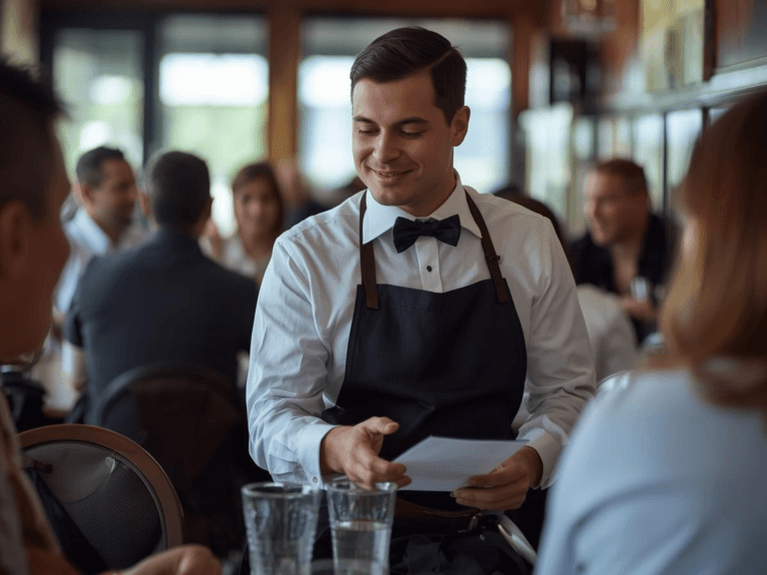
Meet Artie, Ultatel’s AI Host for Restaurants
Picture this: It’s 6:12 PM on a Friday. The host stand is slammed, the expo window is full, and the phone will not stop ringing. A manager picks up to take a to-go order, places the caller on hold, and in those 45 seconds you lose two more calls—and potentially hundreds of dollars in revenue. This is the reality inside busy restaurants. And it’s exactly why the best restaurant operators are moving phone traffic to AI.
In 2025, top restaurant brands—enterprise chains and ambitious independents alike—are deploying AI-powered phone systems to capture every order, eliminate holds, and boost average check size through consistent upsell. Early adopters are reporting dramatic reductions in missed calls, lower labor costs, and ROIs that would make any CFO smile.
Ultatel built its AI Host for Restaurants, for this purpose. It is a voice AI agent that answers every call, manages reservations, takes orders with remarkable accuracy, and integrates with your POS and reservation platforms—so your team can focus on hospitality while a voice AI agent handles the phone.
Below are the five reasons leading restaurants are switching to AI-powered phone systems in 2025—and how a restaurant voice AI agent turns your phone line into a reliable, revenue-generating channel.
1) 24/7 Availability: Never Miss an Order, Reservation, or Question Again
Guests don’t plan their needs around your staffing levels. They call during the dinner rush, after closing, and on holidays. Traditionally, that meant voicemail or waiting a long time on hold. In 2025, AI changes the math.
- Always-on coverage: AI phone agents answer instantly—during peak hours, after hours, and on low-staff days. No call goes unanswered.
- Real-time handling: Calls are handled conversationally, not with clunky IVR menus. The system recognizes natural language and responds immediately, without “please hold.”
- Across use cases: Whether it’s orders, reservations, waitlist requests, allergen questions, directions, or hours—a voice AI agent can manage it all 24/7 with consistent accuracy and brand tone.
Why this matters operationally:
- Restaurants miss up to 10% of calls—often the ones most likely to convert because they’re urgent. Those are lost orders, lost tables, and lost loyalty.
- After-hours inquiries no longer wait in voicemail. Voice AI agents answer, transact, and follow up—so revenue isn’t limited to opening hours.
A restaurant AI host delivers:
- Instant pick-up and natural dialogue that feels human and on-brand.
- Smart routing to humans when needed—no dead ends.
- After-hours workflows for order scheduling, reservation requests, waitlist sign-ups, and FAQ responses.
- Optional SMS follow-ups (e.g., “Your order is confirmed for 7:45 PM,” or “Reply YES to confirm your 6:30 reservation tomorrow.”)
The bottom line: 24/7 availability is not a nice-to-have; it’s a multiplier for sales and guest satisfaction. With a voice ai agent built for restaurants, your phone line finally matches guest expectations for immediacy.
2) Enhanced Workflow Efficiency and Cost Savings: Automate the Busywork, Reinvest in Hospitality
The restaurant phone is a productivity drain. Answering routine calls steals minutes from your host, manager, or bartender at exactly the wrong time. AI removes that friction.
- Automate routine tasks: AI handles orders, reservations, cancellations, modifications, FAQs, and catering inquiries—no human necessary.
- Reduce hold times: Replacing “Can you hold please?”, with immediate answers eliminates the queue that frustrates callers and slows your front-of-house team.
- Fewer interruptions: By deflecting phone traffic from hosts and bartenders, you improve speed-of-service in the dining room and at the bar.
- Lower labor costs: Operators report saving tens of thousands annually by avoiding incremental front of house staffing to catch calls.
- Smarter planning: With predictable call handling, you can staff for the dining room, not the phone.
Why this matters financially:
- Every minute a manager spends on a phone is a minute they’re not on the floor.
- Many concepts pay premium wages for a dedicated phone shift at peak times—just to manage orders and reservations. AI absorbs that wage burden.
- Some pilots report ROIs range from 700-1,700% when AI captures missed sales and reduces phone-related labor.
A restaurant AI agent delivers:
- Conversational automation that feels like a trained host.
- Automatic confirmations, reminders, and cancellations—over voice and optional SMS/email.
- Real-time table and waitlist management synced to your reservation platform.
- Escalation to staff via warm transfer when necessary, ensuring smooth handoffs.
Efficiency is always a competitive advantage. Voice AI frees your team to do what humans do best—welcome guests, solve problems, and create memorable experiences—while the AI eliminates costly or repetitive phone tasks.
3) Revenue Growth via Increased Order Capture Accuracy and Upselling: Turn Calls into High-Converting Sales
Phone calls are high intent. The caller wants to transact. But if you rush the order—you leave money on the table.
- Consistent upselling: AI is relentless (and polite). It can suggest starters, add-ons, drinks, desserts, or limited time offers based on the order context.
- Higher check averages: Intelligent prompts tied to menu logic can raise average order value without pressuring guests—something even great staff can forget in the rush.
- Accurate order capture: Fewer mistakes, fewer refunds, fewer remakes. That preserves margin and guest trust.
- Campaign tie-ins: AI can promote current specials, or loyalty offers to relevant callers based on time of day, location, and caller history.
Why this matters in practice:
- AI upsell models—trained on your menu and historical patterns—can lift order value across every phone transaction, not just on a “good night.”
- Piloting AI for call-in and drive-thru ordering can smooth demand spikes and standardize upsell flow.
A restaurant AI agent delivers:
- Menu-aware recommendations that align with your concept: “Would you like to add a side Caesar or garlic knots to go with those pastas?”
- Daypart logic, menu awareness, and promo scheduling so that suggestions feel helpful, not random.
- Loyalty-aware upsell for known customers, when integrated to your CRM or POS.
Artie doesn’t forget to recommend, never rushes the order, and always follows your playbook. That turns your phone line into a reliable revenue engine.
4) Seamless Integration with POS, Reservation, and CRM: Upgrade Your Phone Without Rebuilding Your Tech Stack
In 2025, you shouldn’t have to rip-and-replace systems to get value from AI. The best AI phone systems plug into your current stack and start delivering within weeks.
- POS integration: Orders placed over the phone flow into your POS automatically for ticketing, payment, and reporting.
- Reservation platform sync: AI sees real-time availability, manages the waitlist, and sends confirmations and reminders.
- CRM enrichment: Caller data—preferences, order history, contact information—feeds your CRM for better marketing and personalized service.
- Modern VoIP backbone: Cloud phone systems with call routing, voicemail-to-email, multi-location support, and analytics make AI deployment straightforward and scalable.
Why this matters:
- Front-of-house and back-of-house run smoother when call handling aligns with live inventory, table status, and staffing.
- Integration prevents manual re-entry errors that lead to bad reviews.
- Enterprise and multi-location operators need consistent data across locations and channels.
A restaurant AI host delivers:
- Integration with leading POS and reservation platforms.
- Respects your existing workflows: pickup/delivery rules, cut-off times, modifiers, kitchen stifling, and order throttles are all configurable.
- Centralized administration for multi-location concepts; local customization by store.
- Works with modern VoIP systems for easy call routing and backup options.
Voice AI agent technology fits the restaurant tech reality: many moving parts, one guest experience. It’s a layer that makes your existing investments more effective.
5) Actionable Data and Analytics: Transform Phone Calls into Insights You Can Use
Traditional phone lines are black boxes. AI turns them into a source of truth about demand, operations, and marketing opportunities.
- Call analytics: Volume trends by daypart, unanswered call rate, intent classification (order, reservation, question), and resolution rates.
- Order and reservation patterns: Which items convert, what upsells work, and average order value by channel.
- Customer profiles: Preferences, allergy notes, previous orders, and frequency—data you can use to personalize service and offers.
- Campaign performance: Tie phone promotions to conversion and revenue, then repeat based on real results.
- Operational signals: Identify peak phone demand windows, and recurring questions your website should answer.
A restaurant AI agent delivers:
- A dashboard built for operators, not data scientists.
- Automated weekly and monthly summaries to your inbox with the metrics that matter: incremental revenue from upsells, average order value lift, top intents, and actionable insights.
- Integration-ready data for your marketing platforms—so you can trigger segmented SMS or email campaigns based on caller behavior.
Data turns decisions into strategy. With a voice AI agent, the phone channel finally pays rent—with insights that drive sales, staffing, and guest experience improvements.
Introducing Ultatel’s Front-of-House Agent That Sounds Like You (On Your Best Day)
Ultatel’s AI Host is purpose-built for restaurant front-of-house. It’s not a generic chatbot. It’s a trained, restaurant-native assistant designed to drive revenue, protect margins, and deliver hospitality at scale.
What sets Ultatel’s restaurant voice AI agent apart:
- Natural, on-brand voice: it uses conversational AI tuned to your brand voice and local dialects—so callers feel welcomed, not “handled.”
- Menu and policy mastery: it is trained on your full menu, modifiers, allergens, and prep-times, plus your policies for cancellations, deposits, and gratuity.
- Reservation intelligence: it manages bookings, waitlists, confirmations, reminders, and rescheduling—pulling live availability from your reservation system.
- POS-connected ordering: Orders are posted directly to your POS with item-level accuracy, pricing, taxes, and prep-time logic.
- Multilingual support: Serve guests in the language they prefer, without needing bilingual staffing on every shift.
- Campaign-ready: Promote limited-time offers, specials, and events with targeted call scripts tied to your marketing calendar.
- Multi-location control: Enterprise-ready permissions and reporting across all stores with store-level customization.
- Always-on reliability: Cloud-hosted, redundant, and monitored—so you’re covered during storms, outages, and holiday demand spikes.
Ultatel’s AI Host for restaurants is the host you wish you could clone—the one who never forgets to upsell, always knows the menu, and doesn’t panic when the phone lights up.
A 30-Day Implementation Playbook: From Kickoff to Captured Revenue
Deploying a voice AI agent shouldn’t be a year-long project. Here’s how operators go live with it—fast.
- Discovery and design (Week 1)
- Align goals: reduce missed calls, raise average order value, improve reservation management, and cut hold times.
- Collect artifacts: menus, modifiers, allergy list, hours by day, holiday rules, reservation policies, delivery zones, payment policies.
- Voice and tone setup: sample greetings, brand phrases, and escalation preferences.
- Integrations and training (Week 2)
- Connect to your POS and reservation systems.
- Import FAQs and policies; map call intents to workflows.
- Configure daypart-specific messaging and offers.
- Pilot and tuning (Week 3)
- Go live in a single location or during after-hours first.
- Monitor call transcripts and outcomes; fine-tune upsell logic and FAQs.
- Train staff on escalations and how to “call Artie” for help during rush.
- Full rollout and measurement (Week 4)
- Expand coverage to all hours and locations.
- Enable weekly executive summaries and location-specific dashboards.
- A/B test upsell prompts and promotional scripts for continuous lift.
With the right VoIP backbone and APIs in place, many restaurants see value within weeks.
Change Management: How to Bring Your Team and Guests Along
Voice AI agent’s success isn’t just about technology. It’s about designing a guest-first experience and setting your team up to win.
- Script the brand voice: Share how “your restaurant speaks” so the voice AI agent matches your hospitality style.
- Train escalations: Teach staff how to jump in on complex or VIP calls and how to “ask Artie” to handle routine tasks.
- Inform guests: Update your website and Google Business Profile to highlight “We answer instantly 24/7.”
- Monitor and iterate: Review weekly insights; update menu logic, promo scripts, and FAQs based on real behavior.
- Maintain human choice: Always give callers an option to speak with a person for sensitive or complex requests.
The goal is not to “replace humans.” It’s to remove friction so humans can do the work that creates loyalty.
Frequently Asked Questions
- Will guests know they’re speaking to AI?
Our front-of-house agent is transparent and on-brand. You can configure a friendly greeting that makes it clear they’re speaking with your virtual host while still feeling personal and intuitive. - Can a restaurant voice AI agent handle complex orders or allergy concerns?
Yes. It is trained on your menu, modifiers, and allergen data, and can confirm modifications, read back orders, and escalate to a human when needed. - What about our existing phone system?
A restaurant voice AI agent works alongside modern cloud VoIP systems for intelligent call routing and redundancy. If you’re on a legacy system, our team can help you evaluate a phased upgrade path. - Does voice AI agent integrate with our POS and reservation tool?
It connects to leading platforms via secure APIs. During onboarding, we confirm compatibility and map your workflows. - How long does implementation take?
Most[AT1] restaurants go live in a few weeks, depending on integrations and pilot scope. - How is payment handled over the phone?
For PCI compliance, a voice AI agent can hand off to a secure payment workflow or transfer to a team member for card entry, depending on your policies. - How do we measure ROI?
To prove ROI, start by tracking captured calls, revenue recapture, average order value lift, upsell conversion, and hold time elimination.
The Takeaway: The Most Profitable Host You’ll Ever Hire
Phones used to be a necessary interruption. In 2025, they’re a controllable, optimizable channel—if you put AI to work.
- 24/7 availability ensures no call goes unanswered.
- Automation slashes hold times and labor drag.
- Consistent upsell lifts average checks.
- Integration keeps the experience smooth for guests and staff.
- Analytics turn every call into insight for your next shift, promo, or staffing plan.
Ultatel’s AI Host for Restaurants makes your phone line perform like a top server on their best night—at scale, every hour you’re open (and even when you’re not).
Ready to see what a restaurant voice AI agent could do for your concept? Schedule a demo with Ultatel and turn your phone into a profit center.
